Dog Arthritis Symptoms: Signs and Indications
How to recognize the signs of arthritis in dogs, from subtle early changes to more obvious mobility problems
Noticing changes in how your dog moves? Talk it through with a MedcoVet clinician. Free, 30 minutes, video or phone.
Medically reviewed by: Christine Cranston MPT, CCRP (Specialties: licensed canine physical therapist, arthritis management, orthopedic injuries, muscle strains, sprains, chronic mobility, neurological conditions, geriatrics, IVDD, and dysplasia)
Last Reviewed: October 2026
Updated: October 2026
What are the signs of arthritis in dogs?
The signs of arthritis in dogs can be easy to miss, especially in the early stages. Common changes include slowness to rise after rest, difficulty with stairs, less jumping or playing, and lameness (Epstein, 2025). You may also notice stiffness, a subtle limp, less interest in activity, or changes in your dog’s behavior.
Some dogs never show an obvious limp. Lameness can be less apparent than expected, even in early disease and even when both sides are affected (Epstein, 2025). Instead, these dogs quietly change how they move, rest, play, or interact with you.
“Animals are naturally stoic, and by the time we begin to recognize the signs of arthritis, the disease has typically already progressed.” — Christine Cranston, MPT, CCRP
That is one reason recognizing small changes matters.
Arthritis, most commonly osteoarthritis, is a chronic degenerative joint disease. Changes within an affected joint can lead to inflammation, pain, stiffness, reduced range of motion, and loss of function over time (Johnston, 1997; Epstein, 2025).
“Any time we see signs of pain in a pet, we should consider arthritis as one possible cause.” — Christine Cranston, MPT, CCRP
Arthritis becomes more common as dogs age. In a large UK primary-care study, dogs older than eight years were more likely to be diagnosed with osteoarthritis (Anderson et al., 2018). But age alone does not determine risk. The same study also linked osteoarthritis to higher body weight and to certain breeds, including Labrador and Golden Retrievers (Anderson et al., 2018).
In that study, roughly 2.5% of dogs seen in primary care were diagnosed with osteoarthritis in a given year, and the condition was estimated to affect 11.4% of an affected dog’s lifespan (Anderson et al., 2018). Because those figures are based on diagnosed cases, they may not capture dogs whose signs went unrecognized.
“Arthritis can affect any joint, at any age, in any breed, and in any species.” — Christine Cranston, MPT, CCRP
What is arthritis in dogs?

Arthritis in dogs is a progressive disease that affects one or more joints. With osteoarthritis, the cartilage that cushions the joint gradually deteriorates, and the joint can develop fluid buildup and new bone growth around its edges (Epstein, 2025). Normal joint mechanics can become altered (Johnston, 1997).
An arthritic joint may become:
- Painful
- Inflamed
- Stiff
- Less stable
- Less flexible
- More difficult to move through its normal range
These changes can eventually affect the way a dog walks, gets up, uses stairs, jumps, plays, and completes normal daily activities.
Pain in an arthritic joint can come from several sources, including the inflamed lining of the joint (the synovium), exposed nerve-rich bone beneath worn cartilage, and an inflamed, thickened joint capsule (Epstein, 2025). Inflammation may also be present when you cannot see obvious swelling.
“With osteoarthritis, inflammation is present, and inflammation has five classic signs. Pain is one of them, which is often what prompts us to take our pets to the veterinarian. Then there is loss of function such as limping. But there can also be heat, redness, and swelling within the joint that we cannot always see or appreciate. The joint can be inflamed even when those signs are not obvious from the outside.” — Christine Cranston, MPT, CCRP
Osteoarthritis is especially common in older dogs, but younger dogs can develop it following injuries, joint instability, or developmental orthopedic conditions such as hip and elbow dysplasia (Smith et al., 2001; Epstein, 2025).
Early signs of arthritis in dogs

Early arthritis does not always look like obvious pain. A dog may simply start moving differently or become less willing to do something that was previously easy.
Watch for:
- Stiffness after sleeping or resting
- Taking longer to get up
- Slower walking
- Hesitation before stairs
- Hesitation before jumping into the car or onto furniture
- A subtle limp that comes and goes
- Shifting weight away from one leg
- Changes in resting position
- Reduced interest in walks or play
- Stopping sooner during activity
- Difficulty settling comfortably
- Mild changes in mood or behavior
These are the kinds of everyday changes that owner-completed questionnaires ask about, such as getting up, using stairs, jumping, and play, when veterinarians screen for osteoarthritis (Walton et al., 2013; Wright et al., 2022).
One of the easiest mistakes to make is assuming these changes are simply part of getting older.
“We often forget that our animals are aging and continue to expect them to do the same things they have always done, such as jumping into the car. That can be unfair to them. We need to make accommodations that allow them to succeed without discomfort, pain, or hesitation.” — Christine Cranston, MPT, CCRP
Pay attention to changes from your dog’s normal behavior. A dog who has always raced to the door but now walks slowly toward it is giving you useful information, even if they are not limping.
Symptoms may also vary from day to day.
“Arthritis commonly waxes and wanes, with flare-ups that can be influenced by factors such as the seasons and weather.” — Christine Cranston, MPT, CCRP
A few good days do not necessarily mean the underlying joint problem has gone away, because osteoarthritis involves progressive deterioration of the joint (Epstein, 2025).
Seeing early signs? Act early
The earlier you support joints, the better the outcome
Hazel Moon
Common signs of arthritis as it progresses
As arthritis progresses, changes in movement and comfort often become easier to recognize.
Common signs include:
- Persistent stiffness
- Limping or favoring one leg
- Difficulty getting up from the floor
- Difficulty climbing stairs
- Reluctance to jump
- Reduced range of motion
- Shorter or slower walks
- Less interest in running or playing
- Increased stiffness following activity
- Muscle loss, particularly around an affected limb
- Changes in posture
- Difficulty finding a comfortable resting position
- Visible or palpable joint swelling in some cases
- Reduced ability to complete normal daily activities
Veterinarians look for several of these on examination, including muscle atrophy, joint swelling, crepitation (a grating sensation), and restricted range of motion (Epstein, 2025).
Difficulty with climbing stairs
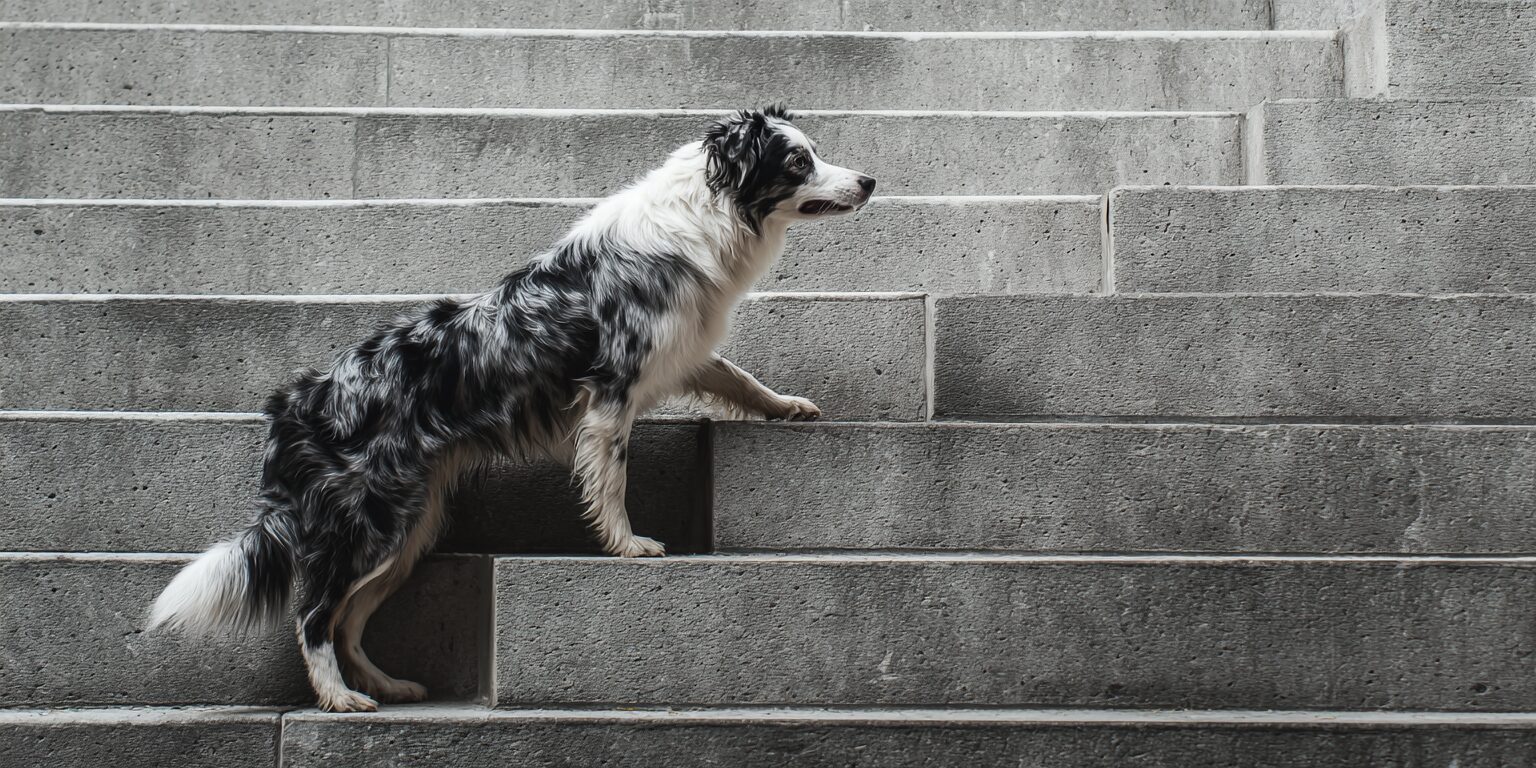
Difficulty with stairs is one of the most common ways owners first notice a problem (Epstein, 2025). You might notice your dog pause at the bottom of the stairs, climb slowly, use a different gait, stop halfway, or avoid the stairs altogether.
“Among senior pets, osteoarthritis is a primary cause of mobility limitations. It is a chronic, progressive disease that can significantly affect their ability to move and function.” — Cathy Symons, CVT, CCRP, CHPT
A change in function is often one of the most useful clues that discomfort may be present.
Arthritis signs at a glance: early vs. progressing
Use this table to compare what early changes and more advanced changes tend to look like in everyday life. Your dog may not fit neatly into one column, and a change in either column is worth mentioning to your veterinarian.
|
What you may notice |
Early signs |
Progressing signs |
Source |
|
Getting up and resting |
Stiffness after sleeping or resting; taking longer to get up |
Persistent stiffness; difficulty getting up from the floor; trouble finding a comfortable resting position |
|
|
Stairs, jumping, and the car |
Hesitation before stairs, the car, or furniture |
Pausing, climbing slowly, or stopping halfway; avoiding stairs; reluctance to jump |
|
|
Walking and gait |
A subtle limp that comes and goes; shifting weight off one leg |
Persistent limp or favoring a leg; changes in gait and posture; reduced range of motion |
|
|
Activity level |
Stopping sooner; less interest in walks or play |
Shorter, slower walks; less running or playing; more stiffness after activity |
|
|
Body changes |
Often none you can see |
Muscle loss near an affected limb; joint swelling in some dogs |
|
|
Mood and behavior |
Mild changes in mood; difficulty settling |
Irritability; moving away when touched; withdrawing; licking or fixating on a joint |
Recognize a few of these?
In a free 30-minute call, a MedcoVet clinician can help you make sense of what you’re seeing, and what your options look like if it is arthritis.
Ella
Behavioral changes in dogs with arthritis
Dogs cannot tell us where they hurt, and many do not cry, whine, or clearly show pain. Behavior may change instead. Pain-related behavior is one of the things that owner questionnaires and clinical metrology instruments are designed to capture (Epstein, 2025; Walton et al., 2013).
Signs can include:
- Becoming more irritable
- Moving away when touched
- Avoiding handling around a painful area
- Spending more time alone
- Sleeping more
- Playing less
- Showing less enthusiasm for walks
- Hesitating before movement
- Becoming reluctant to enter the car
- Avoiding furniture they used to jump onto
- Changes in posture or sleeping position
- Licking or paying unusual attention to a joint or limb
“Behavioral changes, such as choosing not to engage in activities or becoming more irritable or grumpy, can be signs of arthritis, especially when the pet is on the younger side.” — Christine Cranston, MPT, CCRP
Behavioral changes deserve attention even when a dog looks physically normal. A young dog repeatedly refusing an activity they previously enjoyed should not automatically be labeled stubborn or lazy.
The same issue occurs in cats, where joint pain can be particularly difficult to recognize. Degenerative joint disease can be identified in roughly 60% of cats overall and in more than 90% of cats older than 12 (Epstein, 2025), yet owners often notice only subtle changes, such as a cat that no longer jumps to favorite high places (Lascelles, 2010; Klinck et al., 2012).
The key in both dogs and cats is recognizing a change from that individual animal’s normal habits.
Where arthritis affects a dog’s joints
Arthritis can develop in many joints. The hips, elbows, and stifles (knees) are among the most commonly affected (Epstein, 2025). Other joints, including the shoulders, wrists, ankles, feet, and spine, can also be involved.
Some dogs have arthritis in a single joint. Others have changes affecting several joints at the same time.
The location can influence what symptoms you notice. Hip or knee arthritis may cause difficulty rising, climbing stairs, jumping, or using the back legs normally, while elbow or shoulder arthritis may cause a front-leg limp or shortened stride. Arthritis involving the spine can affect posture, flexibility, comfort, and movement.
Breeds prone to arthritis
Any dog can develop arthritis, but some breeds carry a greater risk because they are more likely to develop orthopedic conditions, such as hip and elbow dysplasia, that are associated with later joint degeneration (Epstein, 2025; Smith et al., 2001).
Breeds that have been studied for hip and elbow dysplasia and related joint disease include:
- German Shepherds
- Labrador Retrievers
- Golden Retrievers
- Rottweilers
- Newfoundlands
- Bernese Mountain Dogs
These breeds were the focus of a UK study on hip and elbow dysplasia screening (Lewis et al., 2020), and the first four were examined in a study of degenerative joint disease associated with hip dysplasia (Smith et al., 2001). Labrador and Golden Retrievers were also more likely to be diagnosed with osteoarthritis in a UK primary-care population (Anderson et al., 2018).
Breed risk does not mean arthritis is inevitable, and arthritis is not limited to large dogs. Small dogs, mixed breeds, athletic dogs, working dogs, and young dogs can also develop osteoarthritis. A dog’s individual history, body structure, injuries, weight, activity, and joint health all matter (Anderson et al., 2018; Epstein, 2025).
Why arthritis develops
There is rarely one single explanation for every case of arthritis. Factors associated with osteoarthritis can include:
- Aging and accumulated joint wear
- Hip dysplasia
- Elbow dysplasia
- Previous joint injury
- Joint instability
- Surgical trauma
- Developmental or congenital conditions
- Repetitive stress
- High-impact activity
- Excess body weight
- Changes in biomechanics
Breed, age, body weight, dysplasia, and joint injury are the best documented of these (Epstein, 2025; Anderson et al., 2018).
“Simply aging can contribute to joint degeneration because, in many cases, osteoarthritis is associated with wear and tear on the joints.” — Christine Cranston, MPT, CCRP
Some dogs begin with joints that do not move or fit together normally.
“Congenital conditions can lead to premature wear and tear because pets may move differently as they adapt to and compensate for bodies that function differently.” — Christine Cranston, MPT, CCRP
In other dogs, arthritis develops following an injury or years of repeated stress on a joint.
“Our pets can’t always escape the many factors that contribute to arthritis, including joint injuries, surgical trauma, congenital conditions such as elbow or hip dysplasia, obesity, and repetitive stress associated with sports or recreational activities.” — Christine Cranston, MPT, CCRP
These factors can overlap. A dog may have a developmental joint condition, compensate for it for years, sustain an injury, and carry additional body weight. Each factor can influence how stress moves through the joints.
How arthritis impacts your dog’s quality of life
Osteoarthritis is one of the most common chronic, painful conditions recognized in dogs and cats (Epstein, 2025). Joint pain can affect much of a dog’s daily routine. As movement becomes uncomfortable, a dog may walk less, play less, stop jumping, hesitate on stairs, or spend more time resting.
Reduced movement may then contribute to muscle loss and declining strength, and muscle atrophy is a recognized finding in dogs with osteoarthritis (Epstein, 2025). As strength decreases, normal activities can become even harder.
Arthritis may affect your dog’s ability to:
- Get up comfortably
- Walk normally
- Use stairs
- Get into the car
- Jump onto furniture
- Play
- Exercise
- Find a comfortable sleeping position
- Participate in family activities
- Maintain normal strength and mobility
Behavior can change too. A dog experiencing chronic discomfort may become withdrawn, irritable, less social, or less interested in activities they once enjoyed.
Watching function over time can help you spot these changes earlier. Think about what your dog could comfortably do six months ago compared with what they choose to do today. Veterinarians use similar structured tools, including owner questionnaires and the Canine OsteoArthritis Staging Tool (COAST), to assess and track osteoarthritis over time (Walton et al., 2013; Cachon et al., 2018).
If your dog is already showing these changes, our guide on how to help a dog with arthritis at home covers practical adjustments you can make in daily life.
Arthritis prevention
Not every case of arthritis can be prevented. Genetics, developmental conditions, injuries, age, and other factors may contribute despite good care. There are still practical ways to reduce unnecessary stress on your dog’s joints.
Maintain a healthy body weight
Higher body weight was associated with osteoarthritis in a UK primary-care population (Anderson et al., 2018), and weight optimization is considered essential for dogs that are already overweight (Epstein, 2025). In a long-term Labrador Retriever study, dogs fed a restricted diet for life developed osteoarthritis later than free-fed littermates (Kealy et al., 2002) and showed less radiographic hip osteoarthritis (Smith et al., 2006).
Keep your dog consistently active
Diet, exercise, and body weight have all been studied as modifiable risk factors for hip and elbow joint disease in Labrador Retrievers (Sallander et al., 2006). Regular activity helps maintain muscle strength and normal movement. Exercise should match your dog’s age, health, conditioning, and physical ability, and sudden changes in intensity can place unnecessary stress on joints and soft tissues.
Check your dog’s feet and nails
Nail length is worth checking as part of routine care, but the evidence that trimming changes how a dog moves is limited. A small 2026 study of seven healthy dogs found no differences in gait parameters before and after nail trimming, and its authors suggested that overgrown nails may be a consequence of altered gait rather than a cause (Häusler & Söhnel, 2026).
Address injuries and abnormal movement
Persistent limping, repeated injuries, unusual gait patterns, or reluctance to use a limb deserve veterinary attention. Joint injury and trauma are recognized risk factors for osteoarthritis (Epstein, 2025).
Consider orthopedic health when breeding
Responsible screening for inherited orthopedic conditions such as hip and elbow dysplasia can help reduce the likelihood of passing certain joint problems to future generations. In six UK breeds, hip and elbow scores improved over time under screening programs, in part because of selective breeding (Lewis et al., 2020).
Watch for changes before they become severe
Early recognition matters because dogs often compensate for discomfort long before their limitations become obvious (Epstein, 2025). A subtle change in speed, posture, willingness, or behavior may be the first sign that something is wrong.
When should you talk to your veterinarian?
Contact your veterinarian if you notice persistent or recurring changes such as:
- Limping
- Stiffness
- Difficulty getting up
- Difficulty using stairs
- Reluctance to jump
- Reduced activity
- Joint swelling
- Sensitivity to touch
- Changes in gait
- Muscle loss
- Behavioral changes associated with movement
- Symptoms that are becoming more frequent or severe
Seek prompt veterinary attention for sudden severe pain, an inability to bear weight, major swelling, significant trauma, or an abrupt loss of mobility.
Arthritis shares symptoms with other orthopedic and neurologic conditions, so a veterinarian needs to assess whether arthritis is likely. Diagnosis generally involves a physical and orthopedic examination and often radiographs (X-rays) (Epstein, 2025).
Clinical questions about dog arthritis symptoms
Ready to talk about treatment options?
If your dog has been diagnosed with arthritis, or you suspect joint pain may be affecting their daily life, the next question is usually what you can do about it.
See our complete guide to treating dog arthritis →
It covers the major treatment options, how they fit together, and how to build a plan based on your dog’s needs. If you are specifically interested in photobiomodulation, see Red Light Therapy for Arthritis in Pets. Prefer to talk it through? Book a free 30-minute consult.
Evidence Citations
🐾 Ready to Take the Next Step?
Whether you’re just learning or ready to act — we’ve got you.
👉 Book a Free Consult
Talk to a licensed clinician about your pet’s condition and get a personalized plan. No pressure, just real help.
👉Learn More About the Luma
Explore how our at-home red light therapy device works, why it’s different, and what it can do for your pet.

About the Author
Alon Landa is the CEO and co-founder of MedcoVet, a leader in at-home red light therapy for pets. With over 20 years of experience in medical technology and firsthand involvement in developing the Luma, Alon combines deep technical knowledge with a passion for improving pet health. He regularly collaborates with veterinarians and pet parents to advance photobiomodulation (PBM) care at home.
📍 Based in Boston, MA
📖Read more from Alon here

About the Medical Reviewer
Chris Cranston has over 20 years of hands-on experience in small animal physical rehabilitation and is a trusted voice in pet mobility and recovery. She is co-host of the PetAbility Podcast and was among the first 100 professionals worldwide to earn her Certified Canine Rehabilitation Practitioner credential through the University of Tennessee. Chris founded FlowDog in Massachusetts and continues her work through concierge rehab, consulting, and teaching.
Read More about Chris here.