
Clinical Case Study · Feline Rehabilitation
Can an 18.5-Year-Old Geriatric Cat Still Make Functional Gains With Rehabilitation?
A veterinary rehabilitation case study of osteoarthritis, hind leg weakness, muscle loss, and persistent ataxia.
Written by Cathy Symons, CVT, CCRP, CHPT · Veterinary Rehabilitation & Palliative Care, Medcovet
Patient: neutered male domestic cat, 18.5 years · Case 2872
This 18.5-year-old cat had osteoarthritis and an unsteady gait, but made clear progress after several months of rehabilitation. He stood taller, kept climbing stairs, and could exercise more, even though his hind legs stayed weak and his walk remained abnormal.
Summary
18.5 yrs
patient age at referral
~10+ wks
documented rehabilitation course
7
documented sessions in this record
6
functional gains repeatedly observed
0
change in the ataxic gait
daily → q3d
red light therapy frequency as he progressed
My patient was an 18.5-year-old cat named Sleipnir, a name that seemed appropriate. In Norse mythology, Sleipnir is Odin’s eight-legged horse, known for his speed and endurance. Sleipnir came to me because he could no longer move as well as he used to.
At 18.5 years old, he was still active and friendly and took part in his treatment, but his movement was different. He had osteoarthritis, muscle loss, weak back legs, less hip movement, and an unsteady walk. Sometimes his back legs seemed about to give out, and he would lower his hind legs closer to the floor.
Osteoarthritis is common in older cats but is often under-recognized, because cats tend to conceal pain and show it as changes in activity and mobility rather than obvious lameness (Clarke & Bennett, 2006; Bennett et al., 2012; Lascelles, 2010). Aging itself also brings loss of lean muscle, joint deterioration, and a gradual decline in function (Bellows et al., 2016).
Because of his age, arthritis, muscle weakness, and hyperthyroidism, my goals were to help him stay mobile, keep his joints moving, maintain strength and balance, and protect his quality of life without causing extra stress. This personalized, practical approach matches current advice for managing pain in cats with osteoarthritis (Gruen et al., 2022; Monteiro, 2020; Lascelles, 2010).
Although his walk did not return to normal and he remained unsteady, his abilities improved over the next few months. He stood up straighter, kept climbing stairs, tried harder exercises, greeted me in the hallway, and stayed involved in his treatment. For an older cat, these changes are important.
Disclosure
MedcoVet Luma is a red light therapy device made by MedcoVet. I work with MedcoVet. In this case, Luma was just one part of a larger rehabilitation plan that also used manual therapy, exercise, a home program, and heat. The MedcoVet Luma delivers light at wavelengths of 635 nm and 850 nm, with a total average power output of 1010 mW.
Owner consent
The patient’s owner provided permission for this case study and accompanying photos to be published.
Veterinary note
This case study is for educational purposes and is not a substitute for veterinary advice, diagnosis, or treatment. Cat owners should seek veterinary advice for new or worsening mobility problems and should never give human medications for pain relief unless a veterinarian specifically directs them.
Case Snapshot
Case at a glance
| Patient | Sleipnir, neutered male domestic cat, 18.5 years |
|---|---|
| Relevant history | Osteoarthritis; hyperthyroidism |
| Presenting concerns | Hind-end weakness, unsteady/wobbly back legs, difficulty walking, muscle loss, ataxic gait |
| Key exam findings | Reduced bilateral hip extension, occasional dropping of the hocks, lumbar/lumbosacral crepitus, generalized muscle atrophy, guarding on some stretches; full forelimb range of motion |
| Setting | In-home rehabilitation |
| Interventions | Manual therapy, stretching, therapeutic exercise, balance and proprioceptive work, home exercise program, heat, photobiomodulation (MedcoVet Luma); in-session Class 4 laser |
| Course | Initial evaluation December 2, 2023; repeated in-home visits through March 2024 |
| Outcome | Ataxic gait persisted; improved standing posture, maintained stair climbing, increased exercise tolerance, sustained engagement |
| Clinician | Cathy Symons, CVT, CCRP, CHPT |
| Case | 2872 |
Baseline vs. Outcome
This case mainly looks at the difference between the cat’s improvements and the problems that remained.
| What changed | What did not |
|---|---|
| He repeatedly stood taller during later visits. | His ataxic gait persisted. |
| He continued climbing stairs throughout. | His underlying osteoarthritis remained. |
| He progressed to harder balance and strengthening exercises. | His age-related orthopedic limitations remained. |
| He stayed active and willing to participate. | Hind leg weakness was still part of his clinical presentation. |
| He greeted me in the hallway and showed increased engagement. | Rehabilitation did not restore normal gait or coordination. |
| He recovered quickly from mild post-exercise wobbliness. | This case cannot show which individual therapy caused the changes. |
For this cat, improvement meant being able to do more, even though he still had physical problems. This was better shown by what his owners noticed about his movement than by how his walk looked (Benito et al., 2013; Enomoto et al., 2022). I judged his progress using my own observations and detailed reports from his owners about his daily activity and mobility. We did not use official cat mobility or pain scales during his rehab; instead, we relied on the owner’s daily notes, feedback, and the changes I saw at each visit.
What Do Weak, Wobbly Back Legs Look Like in an Older Cat?
In Sleipnir, his owners first noticed changes in his back legs. He was weak through the hind end, unsteady on his feet, and slower to move around the house. He did not drag his paws, but his hind legs sometimes seemed to buckle, and his walking was poorly coordinated.
In older cats, weak or wobbly back legs can show up as:
- difficulty jumping onto furniture, or stopping jumping altogether
- a low, crouched, or unsteady walk in the hind end
- swaying, staggering, or crossing of the back legs while walking
- slower movement toward food and water bowls
- hesitation at the litter box or around stairs
- the hocks (ankles) dropping closer to the floor
Cats with osteoarthritis often jump less and are less active (Clarke & Bennett, 2006). But these changes can have many causes, such as arthritis, muscle loss, or problems with the spine or nerves (Penderis, 2009). If a cat starts using its back legs differently or gets worse, a veterinarian should check it out instead of assuming it is just old age (Bennett et al., 2012; Lascelles, 2010; Ray et al., 2021). Sudden weakness or inability to use the back legs is an emergency. See the section below on emergencies.
What Is Ataxia in Cats?
Ataxia is a loss of normal coordination. It is caused by a problem somewhere in the system that controls balance and limb position. It is usually grouped into three types by where that problem sits: proprioceptive (spinal cord or nerves), vestibular (inner ear or its brain connections), and cerebellar (the part of the brain that fine-tunes movement) (Penderis, 2009). A cat with an ataxic gait may sway, stagger, place the paws unevenly, or look “drunk” while walking. Ataxia describes how a cat moves; it is not a diagnosis in itself, and a veterinarian must identify the underlying cause (Penderis, 2009).
How Is Mobility Dysfunction Managed in a Geriatric Cat With Osteoarthritis?
Initial Evaluation, December 2, 2023
Subjective
I first evaluated Sleipnir in his home environment on December 2, 2023. His owners reported hind-end weakness in addition to his existing hyperthyroidism and osteoarthritis.
For older cats, mobility changes may show up as difficulty walking, difficulty jumping, slower movement toward food and water bowls, hesitation around the litter box, or changes in how the back legs are used (Clarke & Bennett, 2006; Bennett et al., 2012). In this patient, weakness and gait changes were already clearly evident.
Objective
During that first session, I used a combination of gentle manual therapy and active exercise.
Manual treatment included neck and back massage, passive range of motion (PROM), upper-limb stretching, scapular mobilization, gentle spinal glides, and hind-foot stretching. PROM means I moved his joints through their available range for him rather than asking him to perform the movement actively.
For active work, we used:
- seated and standing weight shifting
- treat-guided reaching
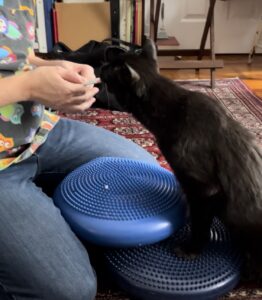
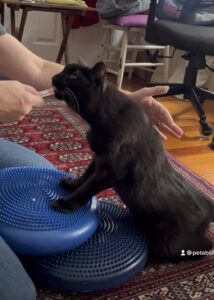
- balance work on a large disc
- step-ups
- step-over exercises
- forward and backward “dancing” movements on the disc
These are standard therapeutic-exercise categories in small-animal rehabilitation, chosen here to challenge balance, proprioception, and strength (Millis & Levine, 2014; Goldberg, 2025). I also used Class 4 laser therapy over the lumbar spine during this initial session.
Assessment
His examination showed clear hind leg weakness and an ataxic gait. I occasionally saw him drop through his hocks. Hip extension was reduced on both sides, and he had generalized muscle atrophy. This pattern is consistent with both osteoarthritis and the muscle loss that comes with aging (Bellows et al., 2016).
I also noted crepitus through the lumbar and lumbosacral region. Crepitus is a grinding or crackling sensation associated with movement; the lumbosacral region is where the lower spine meets the pelvis, and it is among the spinal regions most commonly affected by degenerative change in cats (Kimura et al., 2020).
He was protective when I stretched his left quadriceps, but his front legs could move fully. Despite these issues, he was cheerful and worked well with me.
Plan
I recommended weekly in-home physical therapy, a structured home exercise program (HEP), and adding MedcoVet Luma to his home management plan.
Session takeaway
He started with clear weakness in his back legs and trouble walking. Still, because he was willing to take part, we had a good starting point for gentle rehab. This matters for cats, since they respond best to tailored, low-stress plans (Sharp, 2012; Drum et al., 2015).
Progress Visit, December 14, 2023
Subjective
His owners reported that he was doing well. They were preparing to begin his home therapy program and had ordered a hot pack for use between visits.
Objective
I continued massage, PROM, stretching, spinal and scapular mobilization, weight shifting, balance work, and postural exercises. We also added cone circles, figure-eight walking, low cavaletti rails, and hip-targeted exercises. Cavaletti are low rails that an animal steps over. They encourage careful paw placement, joint movement, balance, and coordination (Goldberg, 2025; Millis & Levine, 2014).
MedcoVet Luma was used over the lumbar spine and both hips for 30 seconds per treatment area.
Assessment
He performed the exercises very well. I did notice guarding with right stifle (knee) extension and left hip extension.
Plan
We continued weekly therapy, the home exercise program, and daily Luma use according to his prescribed protocol.
Session takeaway
He handled the new exercises well, but he was still stiff, guarded some movements, and his back legs stayed weak.
Progress Visit, December 21, 2023
Subjective
He continued to do well at home. His owners reported that he tolerated Luma and particularly liked the hot pack.
Objective
We continued working on flexibility, balance, proprioception, and weight shifting. Proprioception is the body’s sense of limb position; exercises that require controlled, deliberate paw placement challenge it and support postural control (Goldberg, 2025; Sharp, 2012).
His exercises included:
- sideways stepping
- stimulation of the hind paw pads
- balance work
- cone circles
- figure-eight walking
- low cavaletti
- postural exercises
- hip-targeted reaching
Luma was used over the lumbar spine, both hips, both shoulders, and the neck for approximately 30 seconds per treatment area.
Assessment
This was the first visit where I documented a visible postural change: he was standing somewhat taller. His gait was still clearly ataxic, but he continued to participate very well and remained in good spirits.
Plan
We continued weekly rehabilitation, his home exercises, and his home Luma protocol.
Session takeaway
For the first time, he stood taller and showed better posture, even though his unsteady walk did not change.
What Does a Home Exercise Program for a Senior Cat Look Like?
Progress Visit, January 6, 2024
Subjective
His owners were away, but his pet sitter kept up with his exercises. He kept doing well and stayed cheerful. Keeping up the home exercise program helped him keep making progress between visits, and these routines must be practical for the family to do (Drum et al., 2015; Goldberg, 2025).
Objective
We continued his mobility, stretching, balance, and strengthening work and incorporated stair climbing, cavaletti exercises, and hip-targeted movements. From this visit, I lengthened the Luma treatment time over the lumbosacral region and left hip, his most affected areas, to about one minute per spot, while other spots stayed at 30 seconds.
Assessment
His ataxic gait remained present, and he guarded with bilateral hip extension. Even so, he stayed engaged and worked well through the session.
Plan
Rather than asking the family to complete one long exercise sequence, I grouped his exercises into shorter sessions to be performed about three times per week.
Session takeaway
Since his walk was still not normal, I changed his home program to shorter, easier sessions to keep building his strength and mobility.
How Do You Progress Exercises for a Cat That’s Still Ataxic?
Progress Visit, January 18, 2024
Subjective
His owners continued to report that he was doing well, although his ataxia remained.
Objective
We continued manual therapy, stretching, balance exercises, postural work, cavaletti, and hip-targeted reaching. As he tolerated more physical activity, I added modified push-ups and front-limb lifts to challenge his posture and strength. Increasing the difficulty as the patient is able is a key principle of therapeutic exercise (Millis & Levine, 2014).
Assessment
One of my favorite moments from this case happened during this visit: he greeted me in the hallway. He was more engaged with our sessions and again seemed to be standing taller. The ataxic gait was still present. The improvement I saw was in his function and posture, not a return to normal nerve function or gait.
Plan
I added modified push-ups and front-limb lifts to his home program. Follow-up was planned for approximately four weeks.
Session takeaway
We kept making his exercises harder, even though he was still unsteady, because he could handle more and stayed interested.
What Happens When a Very Senior Cat Has a Medical Setback?
Progress Visit, February 10, 2024
Subjective
Before this visit, Sleipnir underwent an ultrasound examination at his primary veterinary clinic. His owners reported that he had a difficult recovery from sedation. He was also receiving an antibiotic that caused diarrhea. Despite that setback, they felt his mobility remained good, and importantly, he was still climbing the stairs.
Objective
I continued his usual rehabilitation program and progressed his balance work with double-disc exercises and controlled head movements. We also used:
- step-over exercises
- supported side-stepping
- front-limb lifts
- hip-targeted reaching
Luma was used over both hips, the lumbar region, and abdominal/lateral areas. Treatment lasted one minute per spot over the lumbosacral region and left hip, and 30 seconds per spot elsewhere.
Assessment
He remained in good spirits and continued standing taller. His ataxic gait was still evident, but he performed his exercises well despite the recent sedation recovery and gastrointestinal problems.
Plan
At this point, I decreased the Luma frequency to every other day, retaining the same treatment sites and per-spot times.
Session takeaway
Even though he had a medical setback that made things harder, he kept moving well and was still able to climb stairs.
How Did His Rehabilitation Progress Over Time?
At his March 23, 2024 visit, his owners reported that he was doing well and eating more. His ataxia persisted, and they planned to have his thyroid function reassessed by his primary veterinarian, which was appropriate because hyperthyroid cats characteristically lose weight and muscle, particularly over the spine, and their weight and muscle condition can change as the disease is treated or progresses (Carney et al., 2016).
I continued progressing his balance, strengthening, postural, and mobility exercises. At this stage, he worked on wooden and wobble discs, step-over activities, hip-targeted reaching, lateral stretching over a peanut-shaped exercise ball, and walking over the peanut toward the couch. Luma was used over both hips, the lumbar spine, and both shoulders for approximately one minute per area.
Once again, he greeted me in the hallway. He participated well and continued to stand taller. I observed some temporary wobbliness in his limbs after exercise, but he recovered quickly. At this visit, I reduced his Luma frequency to every third day, using the same protocol.
Session takeaway
He did harder balance and strength exercises, and any wobbliness after exercise was brief and went away quickly.
How the Rehabilitation Program Evolved
Red light therapy: home protocol as initially prescribed
Sleipnir’s owners followed a structured daily protocol at home, focusing on the lower back and both hips. These were the areas where his osteoarthritis, crepitus, and reduced hip extension were most noticeable.
Home red light therapy protocol
| Step | Target region | Spots | Time / spot | Frequency |
|---|---|---|---|---|
| 1 | Left lower back, between the ribs and the pelvis | 3 | 0:30 min | Daily |
| 2 | Left side: gap between the pelvic bone and the tailbone | 1 | 0:30 min | Daily |
| 3 | Midline: space between the lower back and the tailbone (lumbosacral junction) | 1 | 0:30 min | Daily |
| 4 | Left hip: along the outer edge of the bone | 3 | 0:30 min | Daily |
| 5 | Right lower back, between the ribs and the pelvis | 3 | 0:30 min | Daily |
| 6 | Right side: gap between the pelvic bone and the tailbone | 1 | 0:30 min | Daily |
| 7 | Right hip: along the outer edge of the bone | 3 | 0:30 min | Daily |
| Total | 7 regions | 15 | ≈ 7.5 min / session | Daily |
Figure F · Home treatment map
This daily routine was our starting point. As Sleipnir got better, I increased the treatment time over his left hip and lower back to one minute per spot (January 6, 2024). Later I reduced the frequency to every other day (February 10, 2024) and then to every third day (March 23, 2024). The table below shows these changes.
Non-drug options for arthritis pain mattered a great deal for this patient. His age, overall medical complexity, and the gastrointestinal problems he had during this period narrowed the pain-relief medications that could be used safely, so comfort-focused, non-pharmacologic care carried more of the load than it might for a younger, healthier cat. Red light therapy is widely used for musculoskeletal pain in animals and remains a reasonable option to consider for senior cats with osteoarthritis, particularly when medication choices are limited, while recognizing that the veterinary evidence is still developing and no single best protocol has been established (Millis & Bergh, 2023). Here it was one part of a broader, individualized plan.
MedcoVet Luma protocol over the course of care
| Date | Frequency | Treatment sites | Time per spot |
|---|---|---|---|
| Dec 2, 2023 | Added to home plan | (in-session: Class 4 laser to lumbar spine, 600 J, 5 W) | n/a |
| Dec 14, 2023 | Daily | Lumbar spine, both hips | 30 sec |
| Dec 21, 2023 | Daily | Lumbar spine, both hips, both shoulders, neck | 30 sec |
| Jan 6, 2024 | Daily | Home-protocol sites; longer dwell over the lumbosacral region and left hip | 1 min (lumbosacral region, left hip); 30 sec (other spots) |
| Feb 10, 2024 | Every other day | Same protocol (both hips, lumbar region, abdominal/lateral areas) | 1 min (lumbosacral region, left hip); 30 sec (other spots) |
| Mar 23, 2024 | Every third day | Same protocol | 1 min (lumbosacral region, left hip); 30 sec (other spots) |
Figure 2 · Red light therapy frequency, tapered as the patient progressed
Exercise progression
How the exercise program was built up
| Visit | Added to the program | Targeting |
|---|---|---|
| Dec 2, 2023 | Massage, PROM, scapular mobilization, spinal glides, hind-foot stretches; weight shifts, treat-guided reaching, large-disc balance, step-ups, step-overs, disc “dancing”; Class 4 laser to lumbar spine | Baseline mobility, joint motion, balance |
| Dec 14, 2023 | Cone circles, figure-eight walking, low cavaletti rails, hip-targeted exercises; home program begins; hot pack | Foot placement, coordination, hip motion |
| Dec 21, 2023 | Sideways stepping, hind paw-pad stimulation, small-disc balance | Proprioception, postural control |
| Jan 6, 2024 | Stair climbing; exercises regrouped into shorter sessions ~3×/week | Functional strength; sustainability for caregivers |
| Jan 18, 2024 | Modified push-ups, front-limb lifts | Postural control, forelimb and core strength |
| Feb 10, 2024 | Double-disc balance with controlled head movements, supported side-stepping | Advanced balance under head motion |
| Mar 23, 2024 | Wobble disc, lateral stretch over a peanut ball, walking the length of the peanut | Dynamic balance, trunk flexibility |
Case Timeline & Photo Documentation
Milestones over the rehabilitation course
| Date | Milestone |
|---|---|
| Dec 2, 2023 | Baseline: hind-end weakness, ataxic gait, reduced hip extension, muscle atrophy; cooperative, good spirits |
| Dec 21, 2023 | First documented postural change: standing taller |
| Jan 6, 2024 | Gains maintained by the pet sitter; program shortened to ~3×/week |
| Jan 18, 2024 | Greeted the clinician in the hallway; push-ups and front-limb lifts added |
| Feb 10, 2024 | Difficult sedation recovery and antibiotic-associated diarrhea; still climbing stairs, still standing taller; Luma reduced to every other day |
| Mar 23, 2024 | Appetite up; thyroid recheck planned; peanut-ball work; brief post-exercise wobble with quick recovery; Luma reduced to every third day |
| Throughout | Ataxic gait present the entire time · stair climbing maintained the entire time |
Figure 1 · Rehabilitation timeline
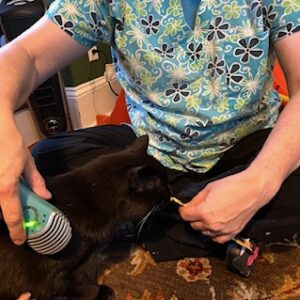
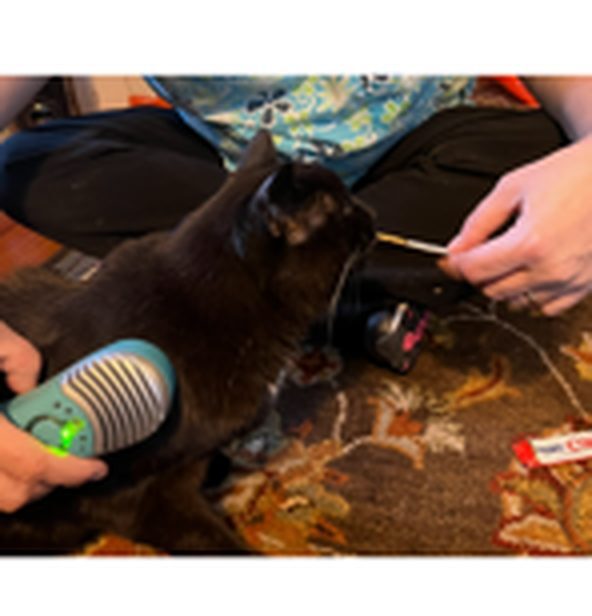
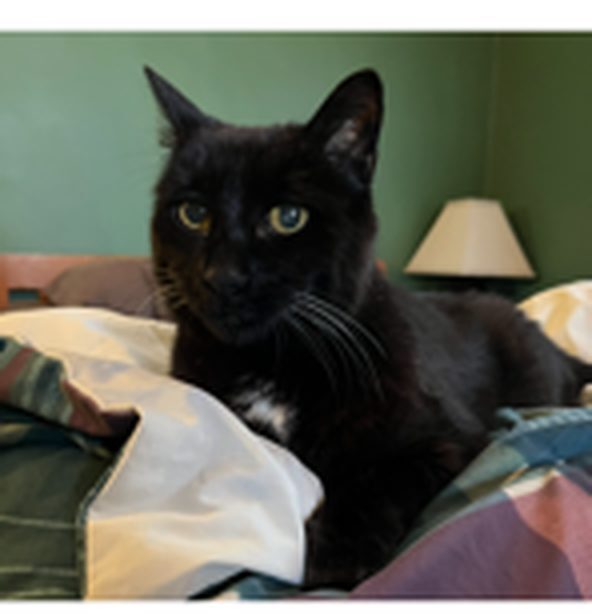
Photo documentation: pet-parent photos, consent on file.
Session video:
What Functional Improvements Did Rehabilitation Produce?
Over the rehabilitation period, I repeatedly observed him:
- standing taller
- continuing to climb stairs
- progressing to increasingly difficult balance and strengthening exercises
- participating in weight-shifting and proprioceptive activities
- greeting me in the hallway before treatment
- engaging willingly with his caregivers and me
- recovering quickly when mild post-exercise wobbliness occurred
His family and pet sitter kept up his exercises between visits. For this older cat, these results were important and helped him keep improving.
When I treat older cats, I look at more than just their back legs. I also think about how well they can move around the house, get to food and water, use the litter box, spend time with family, and do things that make life better. These are the same areas that official cat mobility and pain tools measure (Benito et al., 2013; Enomoto et al., 2022; Monteiro, 2020).
Why Did I Use a Multimodal Rehabilitation Program?
There was not just one problem to solve. Sleipnir had arthritis, muscle loss, less hip movement, weak back legs, and ongoing unsteadiness. His age and other health issues also affected what he could do. Current advice for cats with arthritis and long-term pain is to use several treatments together. This includes hands-on therapy, exercise, weight and home-environment management, and other care, all tailored to the cat (Gruen et al., 2022; Lascelles, 2010; Monteiro, 2020). Since we used these treatments together, we cannot know which one made the difference.
How these methods support mobility
- Manual therapy and stretching support joint and spinal mobility and can ease the guarding seen with a painful, arthritic hind end (Sharp, 2012; Goldberg, 2025).
- Balance, weight-shifting, cavaletti, and proprioceptive exercises challenge postural control and coordination. These systems are most affected in an ataxic cat (Goldberg, 2025; Millis & Levine, 2014).
- Progressive strengthening (step-ups, push-ups, front-limb lifts) targets the muscle loss that accompanies both age and osteoarthritis (Bellows et al., 2016).
- Heat was a comfortable home modality he appeared to enjoy (Sharp, 2012).
- Red light therapy (photobiomodulation) was used as an additional modality, with treatment sites and frequency adjusted over the course of the case. It is a low-stress, comfort-focused option that stays worth considering for senior arthritic cats, particularly when safe medication choices are limited; the veterinary evidence base is still developing (Millis & Bergh, 2023).
- The home exercise program allowed this work to continue between visits and gave his household a role in his care (Drum et al., 2015).
What Does This Mean for a Senior Cat With Mobility Problems?
Older cats frequently have numerous factors affecting mobility at the same time. Osteoarthritis can be painful and is easy to miss (Bennett et al., 2012). Muscle wasting reduces strength through the back legs (Bellows et al., 2016). Spinal disease or nerve damage can affect coordination (Penderis, 2009). That is why a new mobility change deserves veterinary care rather than being assumed to be a normal part of old age (Bennett et al., 2012; Lascelles, 2010; Ray et al., 2021).
In this case, rehab focused on what the cat could still do. His walk stayed abnormal, but he stood up straighter, kept climbing stairs, handled harder exercises, and stayed social. For some older cats, keeping up these abilities is a meaningful goal.
Simple changes at home can help cats move more easily. Experts say litter boxes, food, water, and resting spots should be easy to reach, kept separate, and available in more than one place (Ellis et al., 2013). For a cat with arthritis, this might mean a litter box with a low entry, food and water that are easy to reach, non-slip floors, and steps or ramps instead of jumping (Lascelles, 2010; Gruen et al., 2022). These choices should fit the cat’s health, movement, and home.
When Is Hind Leg Weakness in a Cat an Emergency?
In this case, the gradual hind-end weakness was already under veterinary care. A cat that suddenly develops hind leg weakness is a different situation.
If a cat suddenly cannot use one or both back legs, collapses in the hind end, drags the back legs, or is in obvious pain, contact a veterinarian immediately.
One emergency cause of sudden rear-leg paralysis in cats is feline aortic thromboembolism, also called a “saddle thrombus”, a blood clot that lodges where the aorta branches and cuts off blood flow to the hind limbs. Affected cats typically show acute paralysis, extremely painful and often cold hind limbs, absent femoral pulses, and often fast breathing from the associated heart disease; the condition is usually caused by underlying cardiomyopathy (Guillaumin, 2024; Luis Fuentes et al., 2020). It is life-threatening and needs emergency care.
Sudden difficulty walking can also occur with spinal cord disease or nerve injury (Penderis, 2009), and with trauma. Loss of bowel or bladder control, inability to stand, a front leg also becoming affected, or a sudden change in awareness likewise warrants prompt veterinary care. A veterinary clinic may use a physical and neurologic examination and, depending on the suspected cause, further testing such as blood pressure measurement or imaging.
Concurrent Treatment and Case Limitations
This is a single-patient case report, not a controlled clinical study.
Sleipnir received several therapies at the same time: manual therapy, progressive therapeutic exercise, a home exercise program, heat, and photobiomodulation. Because these interventions were used together, I cannot determine how much any individual component contributed to the functional changes observed. This is a recognized difficulty in rehabilitation, where feline-specific evidence is limited and multimodal programs are the norm (Sharp, 2012; Millis & Bergh, 2023).
His persistent ataxic gait is also important. Rehabilitation did not normalize his gait or remove his underlying osteoarthritis, muscle loss, or age-associated limitations.
Concurrent hyperthyroidism and other medical events may also have affected his mobility. During the rehabilitation period, he had a difficult recovery from sedation and antibiotic-associated diarrhea, and his owners later planned to have his thyroid status reassessed (Carney et al., 2016).
This case is valuable because it documents the clinical course of a very senior cat receiving individualized multimodal rehabilitation.
Looking Back
The key part of Sleipnir’s case is not that his walk stayed abnormal, but that he could still come out to greet me for sessions. Even though he started with weak and unsteady back legs, he became more active and involved. At 18.5 years old, with arthritis and an unsteady walk, being able to move around his home on his own was the best result.
Frequently Asked Questions
What does it mean when a senior cat’s back legs are weak or wobbly?
Wobbly back legs in an older cat usually reflect more than one problem at the same time, such as osteoarthritis, muscle loss in the hind end, and reduced coordination from spinal, nerve, or age-related changes (Bennett et al., 2012; Bellows et al., 2016; Penderis, 2009). Sleipnir had arthritis, muscle wasting, and an ataxic gait together. Because the causes can vary and some are serious, a veterinarian should check any new or worsening change. Sudden weakness is an emergency.
Can physical therapy help a cat with weak back legs?
It can support strength, balance, and coordination, though results depend on the underlying cause and the individual cat, and feline-specific evidence is limited (Sharp, 2012; Drum et al., 2015). In this case, specific exercises, a home program, and other rehabilitation methods helped an 18.5-year-old cat stand taller, keep climbing stairs, and tolerate progressively harder work, even though his ataxic gait did not resolve. A veterinarian or certified rehabilitation practitioner should direct physical rehabilitation for cats.
Can an 18-year-old cat still benefit from rehabilitation?
Very old age does not automatically prevent a cat from participating in rehabilitation (Drum et al., 2015). In this case, an 18.5-year-old cat progressed from basic weight shifting and balance work to stairs, cavaletti, modified push-ups, limb lifts, and more advanced balance exercises. His program changed according to his capacity, medical status, and functional goals.
Does rehabilitation always correct an abnormal gait in a senior cat?
No. Sleipnir’s ataxic gait persisted throughout the documented rehabilitation period. We still observed useful functional changes, including a taller standing posture, continued stair climbing, greater exercise complexity, and strong participation. For geriatric cats, preserving daily function and quality of life may be the most appropriate clinical goal (Monteiro, 2020; Lascelles, 2010).
What can a home exercise program for an elderly cat include?
In this case, the home program included selected strengthening, postural, balance, and mobility exercises based on what the patient could safely tolerate, later grouped into shorter sessions about three times per week (Goldberg, 2025). A home program should be based on the individual cat’s underlying condition, strength, coordination, and home environment.
How often should senior-cat rehabilitation sessions happen?
There is no single schedule for all senior cats. I initially treated this patient weekly and later extended the interval between visits as his program advanced; he continued home exercises in between (Drum et al., 2015). Frequency should reflect diagnosis, stamina, medical status, response to treatment, caregiver capacity, and functional goals.
Is red light therapy (photobiomodulation) appropriate for a very old cat?
Age alone does not determine whether a modality is appropriate. In this case, it was one segment of a wider plan, and its frequency changed over time. Photobiomodulation is commonly used for musculoskeletal pain in animals. Still, the published evidence is limited, and there is no agreed optimal protocol (Millis & Bergh, 2023), so treatment decisions for a geriatric cat should account for the whole medical picture and veterinary advice. For a medically complex senior cat with few safe drug options, it can be a useful, low-risk part of a comfort- and pain-focused plan.
What counts as improvement when a senior cat still walks abnormally?
Improvement can be measured through function. Sleipnir’s gait remained ataxic, yet he stood more upright, continued climbing stairs, completed progressively harder exercises, greeted me for sessions, and remained engaged with his caregivers. Those are the domains that owner-reported feline mobility and pain instruments are intended to capture (Benito et al., 2013; Enomoto et al., 2022).
Clinical Takeaways From Sleipnir’s Case
- An 18.5-year-old cat with osteoarthritis, hind leg weakness, muscle wasting, and ataxia was able to participate in a progressive rehabilitation program.
- Weak, wobbly, or unsteady back legs in an older cat have many causes and should be checked by a veterinarian. They are not simply a normal part of aging (Bennett et al., 2012; Lascelles, 2010).
- His gait remained ataxic throughout the documented treatment period.
- Observable functional changes included standing taller, continued stair climbing, greater exercise capacity, and sustained engagement.
- Rehabilitation combined manual therapy, stretching, therapeutic exercise, balance and proprioceptive work, a home exercise program, heat, and photobiomodulation, consistent with multimodal guidance for feline osteoarthritis (Gruen et al., 2022).
- The home program was shortened to ~3×/week sessions as treatment progressed, helping caregivers preserve consistency (Drum et al., 2015).
- A difficult recovery from sedation and antibiotic-associated diarrhea occurred during the rehabilitation period, yet his owners continued to report useful mobility.
- Sudden paralysis, cold paws, severe pain, or sudden inability to use the hind limbs is an emergency and requires immediate veterinary care (Guillaumin, 2024).
- Because several interventions were used concurrently in a single patient, this case cannot establish that any one treatment caused the observed changes.
About the Author
Cathy Symons, CVT, CCRP, CHPT, is a Certified Veterinary Technician, Certified Canine Rehabilitation Practitioner (University of Tennessee, 2003), and Certified Hospice and Palliative Care Technician with more than 35 years in veterinary medicine. She began her career at Angell Animal Medical Center, co-founded Sterling Impression Animal Rehabilitation Center, and co-hosts the PetAbility podcast. Her clinical focus includes arthritis, joint pain, IVDD, mobility loss, post-surgical recovery, and palliative care. Full bio
Case prepared with pet parent consent.
References
Medcovet Clinical Case Studies
Case 2872 · Sleipnir · prepared with pet parent consent


